The walls of homes in Mithila were once the canvas for Madhubani paintings, created by women for weddings, festivals, and auspicious occasions. Gods and goddesses, people, animals, birds, flowers, and elements of nature came together in these paintings, each finding its place among intricate lines and patterns.
For the women who created them, these weren't simply paintings. They were part of the life of the home — expressions of celebration, faith, tradition and everyday life.
Today, Madhubani is recognised far beyond Mithila. It has found its way onto paper, canvas, textiles and contemporary décor, while retaining the distinctive visual language that makes it instantly recognisable.
But how did a painting tradition that once belonged to the walls of village homes travel so far?
Let's take a closer look.
A tradition rooted in Mithila
Madhubani, also known as Mithila painting, has its roots in the Mithila region of Bihar and adjoining parts of Nepal. It is a deeply rooted tradition, believed to have been passed down through generations, with strong cultural associations with the ancient land of Mithila and the stories of the Ramayana.
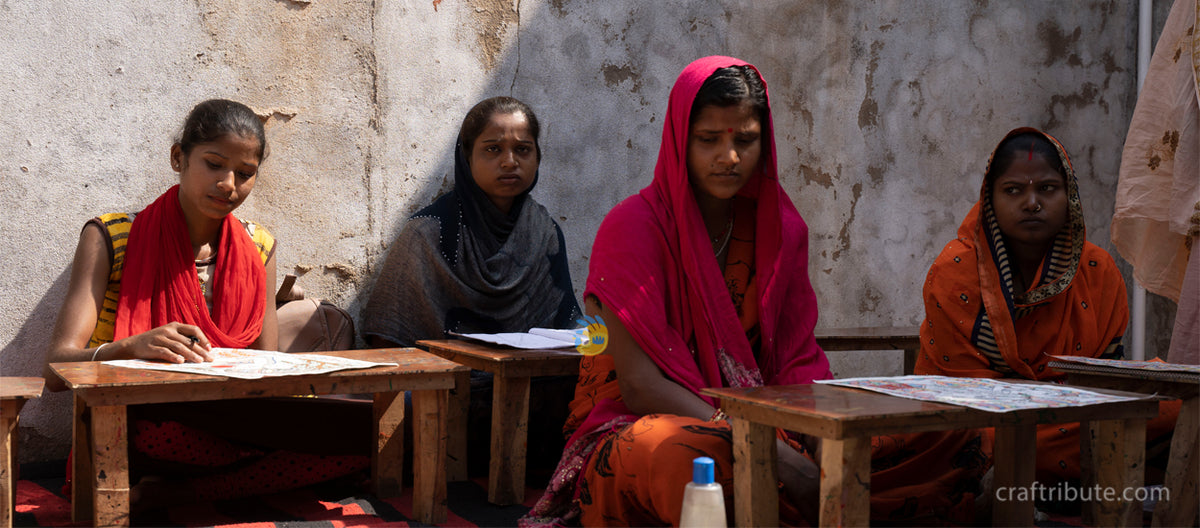
The knowledge of painting was traditionally passed down within families, particularly among women. A daughter learnt from her mother, who had learnt from hers. Over time, each generation added its own experiences and interpretations while retaining the visual language of the tradition.
The art was not created as something separate from life. It was part of life.
When Madhubani moved from walls to paper
The wider world began to take notice of Mithila painting in the 20th century. After the 1934 Bihar earthquake, British civil servant and art historian W. G. Archer documented the paintings he encountered on the walls of homes in the region.
But it was the difficult years of the 1960s that brought a significant change in the journey of Madhubani.
A severe drought affected Bihar in the mid-1960s, creating immense hardship for communities in Mithila. As part of an effort to create livelihood opportunities, Pupul Jayakar, associated with the All India Handicrafts Board, initiated a programme encouraging women to recreate their traditional wall paintings on paper. Bhaskar Kulkarni, a Bombay-based artist, was commissioned to help take the initiative forward.
The change was simple but significant. These paintings had always been part of the home, created for particular occasions and rituals. Creating them for sale was not taken very positively by society.
But this marked the beginning of a new chapter.
What had once been a deeply personal part of domestic and ritual life had found a new way to travel.
Artists such as Jagdamba Devi, Sita Devi and Ganga Devi went on to gain wider recognition, helping take Mithila painting to audiences across Bharat and abroad.
Main Styles
Over time, different approaches have developed within the tradition, each with its own character. Bharni is known for its vibrant use of colour, with outlined forms filled with strong shades. Deities & the stories from the Puranas are often at the centre stage in this style.
 Kachani takes a more linear approach. Fine lines, hatching, and cross-hatching create shading, texture, and depth.
Godna draws inspiration from traditional tattoo patterns, using repeated linear and geometric motifs.
Tantrik paintings are associated with spiritual and religious themes and sacred imagery.
Kohbar paintings are traditionally associated with marriage ceremonies and feature imagery connected with fertility, prosperity, love and marital life.
These categories help us understand the different visual approaches within Madhubani, but they aren't rigid boundaries. Contemporary artists continue to experiment with subjects, colours and materials while drawing from the traditional vocabulary.
The Freehand Tradition
Another fascinating aspect of traditional Madhubani is easy to miss.
It is essentially a freehand art form.
Artists did not traditionally use rulers, compasses, or protractors to create perfectly straight lines, circles, or geometric symmetry. So a line may not be perfectly straight. A circle may be slightly uneven. Two motifs may not be exactly symmetrical. To eyes accustomed to machine-made precision, these variations can initially look like imperfections.
But they are also part of the character of handmade art.
This is particularly worth remembering when you come across Madhubani designs on fabrics and other products today. Some may be hand-drawn or hand-painted, while others may be printed or created using stencils.
If you are looking for a hand-drawn piece, look closely at the lines, repeated motifs, and colour application. Small variations in line thickness, spacing, or brushwork can be part of the evidence of the artist's hand.
And perhaps those little differences are worth appreciating rather than correcting. We'll explore that thought more deeply in our Craft Journal.
Madhubani today
From the walls of Mithila to paper, canvas and fabric, Madhubani has travelled a remarkable distance. Artists today continue to work with traditional motifs and subjects while exploring new themes, materials and formats. The ability to evolve is perhaps one of the reasons Madhubani remains so relevant today. A living tradition doesn't necessarily stay unchanged. It grows, adapts, and finds new ways to speak to each generation.
Where can you find Madhubani art in Thane?
If you are in Thane and would like to explore handcrafted Madhubani paintings, you can visit Craftribute – Store with a Soul in Naupada.
Our collection brings together original works by state and national award-winning artists, along with handcrafted art and décor from different regions and traditions of Bharat.
If you visit, take your time with the pieces. Look at the lines, patterns, and details. Ask about the artist, style, and technique. Because sometimes, knowing the story behind a piece is what makes you fall in love with it.
If you are not from Thane or Mumbai, you can visit our virtual store, craftribute.com, to explore our collection. Our paintings can be safely shipped to your home anywhere in the world.